
Introduction
In the context of accelerated digital transformation of the corporate sector and the widespread transition to the SaaS model, the key factor of competitiveness for B2B platforms is no longer limited to functional completeness, but increasingly includes the quality of user experience, the speed of operations, and the economic efficiency of the product. In recent years, these parameters have been significantly influenced by the integration of generative artificial intelligence (GenAI) models, which can not only automate individual operations but also transform the very logic of user interaction with digital systems. Unlike classical machine learning algorithms, primarily oriented toward prediction and classification, generative models enable the creation of content, adaptive interface elements, and intelligent real-time hints, which determines their growing role in the architecture of modern B2B SaaS solutions.
The relevance of this study is determined by the need for a comprehensive analysis of the impact of GenAI on the key parameters of corporate digital platforms – their architecture, user behavior, and product economics. Despite the active adoption of generative models in applied business scenarios, the academic literature still lacks systematized research that simultaneously considers UX effects, operational changes, and financial metrics of B2B SaaS products. The aim of this work is to identify the patterns of influence of generative artificial intelligence on user scenarios, operational processes, and economic indicators of corporate B2B SaaS platforms based on the analysis of real-world implementation cases.
The scientific novelty of the study lies in the integral consideration of GenAI as an architectural, UX, and economic factor in the development of B2B SaaS products, as well as in the empirical verification of the identified effects. Within a unified analytical framework, changes in user interaction, operational processes, and product economics are compared in the context of implementing intelligent algorithms for routing, trip grouping, and interface adaptation. The practical significance of the work is reflected in the possibility of using the obtained results for designing and scaling corporate SaaS solutions, assessing the investment feasibility of GenAI adoption, and optimizing time-to-task, support workload, CSAT, and NPS indicators in the B2B segment.
Methods
The study relies on a combination of theoretical–analytical review and a case-oriented approach. At the theoretical level, it examines academic publications and industry reports on the integration of GenAI into B2B SaaS platforms, the evolution of user experience in corporate digital products, and the application of classical and generative machine-learning methods to business process optimization. The empirical part of the research is based on the analysis of a practical implementation of intelligent algorithms for routing, trip grouping, and interface adaptation in a B2B corporate mobility platform (taxi and carpooling service for company employees), complemented by a review of publicly available corporate cases from major international providers of digital platforms. The assessment of effectiveness draws on a set of operational and product metrics, including time-to-task, the share of successfully completed user scenarios, the dynamics of support requests, and changes in CSAT and NPS indicators; additional attention is given to how the increased intelligence of processes affects the scalability, resilience, and economic parameters of the SaaS platform.
Main part. GenAI in the architecture of B2B SaaS platforms
The integration of GenAI into the architecture of B2B SaaS platforms leads to the formation of a new class of digital systems in which intelligent models cease to function as external analytical services [1]. In traditional SaaS architectures, machine learning is typically implemented in the form of separate forecasting or recommendation services operating in an asynchronous mode. Generative models, by contrast, are embedded directly into the contour of user interaction, application logic, and process orchestration, providing continuous intelligent support of operations in real time. This requires a profound transformation of architectural solutions, including the deployment of low-latency inference services, context-aware request management mechanisms, and specialized layers for interaction between generative modules and transactional subsystems. For a visual illustration of the transformation of architectural interaction between the user interface, server logic, and intelligent modules, fig. 1 presents a conceptual scheme of integrating classical ML services and a GenAI layer into a B2B SaaS platform.
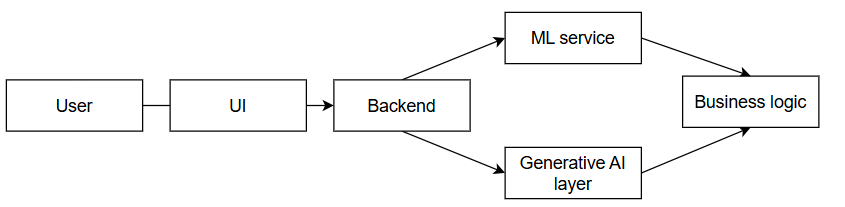
Figure 1. Conceptual scheme of integrating classical ML services and a GenAI layer into the architecture of a B2B SaaS platform
Source: developed by the author
From an architectural perspective, GenAI in B2B SaaS is implemented as a multi-layer structure comprising the data layer, the intelligent processing layer, and the application layer (table 1).
Table 1
Multi-layer architecture of B2B SaaS platforms with embedded GenAI [2]
| Layer | Functional purpose | Typical components | Role of GenAI |
| Data layer | Collection, storage and streaming processing of data. | Event logs, data warehouses, telemetry, user interaction traces. | Formation of contextual input for generative inference. |
| Intelligence layer | Analytics, prediction and generation. | Large language models (LLMs), routing models, classifiers, optimization algorithms. | Generation of content, adaptive logic, recommendations and decision support. |
| Application layer | Business logic and user interfaces. | APIs, workflow engines, frontend UI components. | Embedding generative outputs into UX and operational scenarios. |
The orchestration layer governing the interaction between microservices, the user interface and intelligent models is of particular importance in the architecture of B2B SaaS platforms with GenAI. To ensure stability and predictability of operation, event-driven architectures, message queues and intermediate context-aggregation services are employed to minimize latency when invoking generative models. In addition, mechanisms for output quality control, filtering of generated content and logging of model decisions for subsequent audit are introduced. This is particularly critical in corporate environments, where requirements for reproducibility, security and regulatory compliance are substantially higher than in consumer-oriented SaaS products. The integration of GenAI also transforms approaches to scaling B2B SaaS platforms, shifting the focus from traditional models of horizontal expansion towards adaptive management of computing resources that takes into account the stochastic nature of intelligent workloads (table 2).
Table 2
Scaling approaches for B2B SaaS platforms with GenAI [3, 4]
| Scaling dimension | Traditional B2B SaaS | B2B SaaS with GenAI |
| Load profile | Deterministic, mainly dependent on the number of users | Stochastic, dependent on user count, prompt complexity and context size |
| Compute resources | Predominantly CPU-based | Hybrid CPU and GPU infrastructure |
| Autoscaling strategy | Horizontal scaling of stateless services | Adaptive autoscaling based on request complexity and inference latency |
| Caching mechanisms | API response caching | Context-aware caching of intermediate inference results |
| Latency management | Predictable response times | Variable latency requiring dynamic load balancing |
| Adaptability to user behavior | Limited, scenario-driven | High, driven by real-time generative interaction |
A distinct architectural aspect is associated with ensuring information security and data isolation in corporate SaaS environments when GenAI is employed. In the context of processing sensitive commercial information, mechanisms for separating contexts between tenants, controlling potential data leakage through generative outputs, and implementing specialized anonymization and pseudonymization pipelines become particularly important. Generative modules embedded into the architecture of B2B SaaS platforms are complemented by access-control systems, logging, and post hoc analysis of decisions, which helps minimize the risks of uncontrolled dissemination of corporate data.
Overall, the integration of GenAI into the architecture of B2B SaaS platforms marks a transition from a classical service-oriented model to intellectually adaptive digital ecosystems. Generative models begin to perform not only auxiliary functions but also participate in shaping user scenarios, supporting operational decision-making, and optimizing business processes. This creates a technological foundation for subsequent transformations of user experience and product economics, which are examined in the following sections of the study.
Impact of GenAI on digital UX
According to one of the industry analytical reports, the global GenAI market was valued at $16.87 billion in 2024, and is projected to grow to $109.37 billion by 2030, which indicates high investment activity and the strategic importance of generative technologies for the development of SaaS platforms and corporate digital ecosystems (fig. 2).
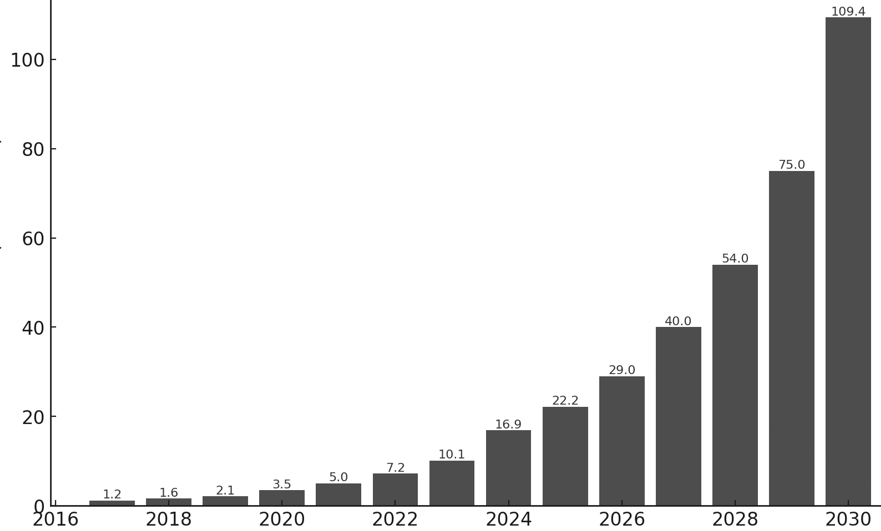
Figure 2. Global GenAI market growth (2017–2030), billion dollars
Source: author’s visualization based on data from [5]
The rapid growth of the global GenAI market, illustrated in fig. 2, is accompanied not only by an expansion of investment activity and technological infrastructure, but also by a profound transformation of applied user scenarios in B2B SaaS products. The scaling of generative technologies in corporate platforms drives the transition from experimental use of AI to its systematic integration into user interfaces and operational workflows, which makes the analysis of the impact of GenAI on digital user experience fundamentally significant from both scientific and practical perspectives (table 3).
Table 3
Impact of GenAI on digital user experience in B2B SaaS platforms [6, 7]
| UX aspect | Traditional B2B SaaS | B2B SaaS with GenAI |
| Interface design | Static interfaces with predefined layouts and logic. | Dynamically adapting interfaces based on user role and context. |
| Interaction model | Interaction through forms, tables and menu hierarchies. | Hybrid interaction combining classical UI and natural language. |
| Personalization | Limited personalization based on fixed business rules. | Deep real-time personalization driven by generative inference. |
| Data input | Manual data entry with post-processing validation. | Automatic field completion with intelligent real-time validation. |
| Cognitive load | High cognitive load due to complex multistep procedures. | Reduced cognitive load through contextual hints and guidance. |
| Workflow organization | Rigid linear workflows with fixed sequences of actions. | Adaptive workflows dynamically changing according to context. |
| Time-to-task | Relatively long execution time for typical user actions. | Significantly reduced time due to automation and assistance. |
As the presented comparative analysis demonstrates, GenAI has a systemic impact on all key components of digital user experience – from interface structure to workflow organization and the speed of task execution. The transition from static, regulated interfaces to context-adaptive and dialog-based forms of interaction is accompanied by a reduction in cognitive load, an increase in the accuracy of user actions, and a decrease in the share of incomplete scenarios. At the level of operational metrics, this is reflected in a consistent reduction of time-to-task, a lower number of input errors, and a higher proportion of successfully completed user operations. Thus, UX transformation under the influence of GenAI acquires not only a qualitative, but also a quantitatively measurable character, establishing a direct link between the intellectualization of interfaces and the economic efficiency of B2B SaaS products.
Optimization of B2B SaaS operational processes using GenAI
The integration of GenAI into B2B SaaS platforms leads not only to transformations in architecture and user experience, but also to a profound reconfiguration of operational processes. Unlike classical automation tools, which are primarily focused on supporting predefined workflows, GenAI enables context-aware orchestration of operations, dynamic decision support, and real-time adaptation of process logic to changing business conditions. This shifts the focus in operational management from rigid rule execution to intellectually adaptive process environments.
Generative models embedded into the operational layers of B2B SaaS platforms enhance process efficiency through intelligent task routing, automated handling of requests and documents, proactive anomaly detection, and optimization of resource allocation. In high-load corporate environments, such mechanisms allow a substantial reduction in the share of manual operations, shortening of operational cycles, and an increase in overall system throughput. As a result, GenAI becomes a key driver of operational scalability and resilience in complex multi-tenant SaaS infrastructures (table 4).
Table 4
Impact of GenAI on core operational processes in B2B SaaS platforms [8, 9]
| Operational aspect | Traditional B2B SaaS | B2B SaaS with GenAI |
| Task routing | Static assignment based on fixed rules. | Context-aware dynamic routing. |
| Process execution | Sequential, predefined workflows. | Adaptive flows that self-adjust to the current context. |
| Incident handling | Reactive response and manual escalation. | Proactive detection and partially automated resolution. |
| Resource allocation | Static capacity planning. | Intelligent real-time optimization of resource usage. |
| Operational latency | Strongly dependent on human intervention. | Reduced through automated inference. |
| Scalability | Driven predominantly by infrastructure resources. | Supported by a combination of infrastructure and “intelligence-driven” scalability. |
| Process resilience | Limited by predefined failover and contingency scenarios. | Enhanced through predictive and generative adaptation. |
As the comparison shows, GenAI shifts operational management in B2B SaaS platforms from deterministic automation to intellectually adaptive process control. The implementation of dynamic task routing, proactive incident handling, and real-time resource optimization reduces operational latency and dependence on manual supervision, while simultaneously increasing system scalability and resilience under variable load conditions. In operational metrics, this is reflected in shorter processing cycles, fewer failures and disruptions, and lower unit operating costs. Thus, process optimization driven by GenAI acquires a direct economic dimension and forms a link between technological transformation and the performance of B2B SaaS products, which becomes the focus of the subsequent section on product economics.
Impact of GenAI on the economics of SaaS products
The integration of GenAI into B2B SaaS platforms has a direct and quantitatively measurable impact on the economic performance of digital products. Unlike effects that are confined to architectural or UX changes, the economic influence of GenAI is reflected in revenue dynamics, cost structure, scalability indicators, and the financial sustainability of the SaaS business. Generative technologies affect both the revenue and cost sides of the economic model by accelerating the creation of user value, increasing product usage intensity, and reducing operational expenditures.
From the revenue perspective, GenAI strengthens the value of a SaaS product through deep personalization, reduced task completion time, and higher productivity of corporate users. This contributes to improved retention, higher average revenue per customer, and broader adoption of the platform within existing contracts, which is reflected in the growth of customer lifetime value and net revenue retention. Shorter user onboarding periods and faster transition to productive use further increase conversion rates in corporate funnels and accelerate enterprise deal closure.
From the cost perspective, GenAI reduces the load on support and operational teams by automating a substantial share of consultations, incident diagnostics, and user assistance. Intelligent self-service, proactive error prevention, and partially automated incident resolution help to decrease ticket volumes and average handling time. In addition, the optimization of workflows and resource allocation lowers the unit cost of SaaS service delivery, which positively affects the product’s gross margin (table 5).
Table 5
Economic impact of GenAI integration in B2B SaaS products [10, 11]
| Economic metric | Traditional B2B SaaS | B2B SaaS with GenAI |
| Customer acquisition cost (CAC) | High due to complex onboarding and training. | Reduced through intelligent onboarding and contextual assistance. |
| Customer lifetime value (LTV) | Moderate growth driven by functional expansion. | Accelerated growth due to higher retention and usage intensity. |
| Net revenue retention (NRR) | Relatively stable, driven by contract renewals. | Increasing through upsell, cross-sell and usage-based expansion. |
| Support costs | Significant share of operating expenses. | Decreasing due to automation and AI-driven self-service. |
| Gross margin | Constrained by support and operational overhead. | Improved through lower unit service delivery costs. |
| Time-to-value | Long ramp-up period before reaching productive use. | Shortened thanks to adaptive UX and intelligent guidance. |
| Revenue scalability | Proportional to workforce growth. | Outpacing workforce growth due to automation effects. |
The economic impact of GenAI on B2B SaaS products is twofold, affecting both revenue generation and cost structure. Increases in user productivity, faster onboarding, and improved retention directly contribute to the expansion of the revenue base of SaaS platforms. At the same time, the automation of support, operational processes, and resource allocation leads to a structural reduction in operating costs and an improvement in gross margins. As a result, GenAI evolves from an auxiliary technological function into a core economic driver of the SaaS business model, reinforcing the financial sustainability and investment attractiveness of corporate digital products.
Empirical examples of GenAI implementation
Empirical validation of the effects of GenAI in B2B SaaS requires the analysis of concrete corporate mobility cases, where intelligent routing, trip pooling, and workflow automation directly affect time-to-task, completion rates, support load, and customer satisfaction.
In one case, a large telecommunications company operating a B2B corporate mobility service for a network of call centers faced high manual overhead: administrators spent 2–3 hours per day creating requests for more than 100 vehicles, repeatedly entering similar data for each employee, which led to errors and high operational costs. The introduction of a bulk trip-creation tool combined with route optimization and passenger-grouping algorithms reduced order creation time to 10 minutes per day, increased the share of completed trips from 50 % to 90 %, cut support tickets related to trip creation by 50 %, and enabled scaling from 1 to 5 call centers within two months, adding about 11,000 rides per month with an average ride value of $15. In product terms, this reflects a sharp reduction in time-to-task for administrators, higher scenario completion, and a lower support burden, which directly improves the economic efficiency of the B2B platform. All figures are presented in aggregated and anonymized form.
A second case illustrates the scaling of AI-integrated corporate mobility at the level of a distributed network of cities. A modular “virtual taxi operator” platform was developed to connect local taxi fleets and corporate customers into a single digital ecosystem. After a pilot with about 500 vehicles and an 85 % order completion rate, the solution was rolled out to 12 cities, where it captured roughly 30 % of the B2B mobility segment. AI-based optimization increased the overall completion rate to 92 %, reduced average driver waiting time by 25 %, and shortened average trip time by 15 %, resulting in approximately $230,000 in monthly savings, a 12 % increase in B2B revenue, and a 70 % reduction in the cost of entering new cities compared to a traditional expansion model. These data are also aggregated and anonymized.
Experience from U.S. companies shows that the next step in this evolution is linked to GenAI. Lyft integrated the Claude (Anthropic) generative model via Amazon Bedrock into its customer support stack, launching an AI assistant that processes thousands of user and driver requests per day and handles routine queries while escalating only complex issues (safety, fraud, deactivation) to human agents. According to the company, this reduced average time-to-resolution by 87 %, significantly lowered the load on first-line support, and improved CSAT/NPS while containing the cost of scaling the support function [12].
Taken together, these empirical examples indicate that the integration of intelligent and generative algorithms into corporate mobility not only improves user and operational experience but also generates sustainable, measurable economic effects.
Conclusion
The study demonstrates that the integration of GenAI into B2B SaaS platforms has a systemic character and exerts a comprehensive impact on digital product architecture, user experience, operational processes, and the overall economics of SaaS businesses. It is shown that GenAI transforms traditional service-oriented models into intellectually adaptive digital ecosystems, enables deep interface personalization, reduces temporal and transactional costs, enhances the resilience of operational workflows, and drives growth in key product and financial metrics. Empirical evidence from the corporate mobility domain confirms that the deployment of intelligent and generative algorithms leads to a measurable reduction in time-to-task, an increase in the share of successfully completed scenarios, a decrease in support workload, and an improvement in the economic efficiency of platforms. Taken together, the findings allow GenAI to be regarded not merely as an auxiliary automation tool, but as a strategic factor for strengthening the competitiveness and long-term sustainability of B2B SaaS products.
Библиографический список
1. Simaremare, M., Edison, H. The state of generative AI adoption from software practitioners' perspective: An empirical study // 2024 50th Euromicro Conference on Software Engineering and Advanced Applications (SEAA). IEEE. – 2024. – P. 106-113.2. Mavridou, E., Vrochidou, E., Selvesakis, M., Papakostas, G. A. Beyond Accuracy: Benchmarking Machine Learning Models for Efficient and Sustainable SaaS Decision Support // Future Internet. – 2025. – Vol. 17. – № 10. – P. 467.
3. Bordusenko, D. Integration of machine learning into management accounting systems: forecasting operating costs and profitability in manufacturing // Cold Science. – 2025. – № 22. – P. 70-81.
4. Petrenko, A. Agent-based approach to implementing artificial intelligence (AI) in service-oriented architecture (SOA) // System research and information technologies. – 2025. – № 1. – P. 104-123.
5. Generative AI Market / GVR Report // URL: https://www.grandviewresearch.com/industry-analysis/generative-ai-market-report (date of application: 26.12.2025).
6. Takaffoli, M., Li, S., Mäkelä, V. Generative AI in user experience design and research: how do UX practitioners, teams, and companies use GenAI in industry? // Proceedings of the 2024 ACM Designing Interactive Systems Conference. – 2024. – P. 1579-1593.
7. Pilaniwala, P. Artificial Intelligence in Product Management: Enhancing User Experience Personalization through GenAI // 2024 3rd international conference on automation, computing and renewable systems (ICACRS). IEEE. – 2024. – P. 1135-1140.
8. Naidenova, M. Automated procurement system in construction based on ERP (1C), EDI, and BIM: architecture, integration principles, and managerial impact // International Journal of Civil Engineering and Architecture Engineering. – 2025. – Vol. 6(2B). – P. 85-90.
9. Moroz, B., Saltan, A., Hyrynsalmi, S. A Process Model of Product Strategy Development: A Case of a B2B SaaS Product // International Conference on Product-Focused Software Process Improvement. Cham: Springer International Publishing. – 2022. – P. 181-200.
10. Robayo-Pinzon, O. Generative artificial intelligence (GenAI) use and dependence: an approach from behavioral economics // Frontiers in Public Health. – 2025. – Vol. 13. – P. 1634121.
11. Zharmagambetov, Ye. Using synthetic data to model a portfolio in conditions of high volatility. How synthetic data allows you to test strategies for rare market events. Examples of generative models application // The American Journal of Management and Economics Innovations. – 2024. – Vol. 6. – № 12. – P. 55-62.
12. Lyft and Anthropic Team Up to Redefine Customer-Obsessed AI / Lyft // URL: https://www.lyft.com/blog/posts/lyft-and-anthropic-team-up-to-redefine-customer-obsessed-ai (date of application: 26.12.2025).